How to Spot a Good Bike Before You Buy It
A good bike is one that fits your body and intended riding, works safely, and can be maintained at a cost that makes sense. Before buying, check the fit, frame and wheels, brakes, gears, tires, and service history, then take a test ride. These checks matter whether you are considering a new or used bike: the U.S. Consumer Product Safety Commission (CPSC) sets bicycle safety requirements, while the National Highway Traffic Safety Administration (NHTSA) reported that 1,166 bicyclists died in U.S. traffic crashes in 2023. A careful inspection cannot eliminate every risk, but it can help you avoid a poor fit, unsafe components, and expensive surprises.
A good bike’s fit and purpose
A bicycle is a human-powered vehicle whose suitability depends on how well its design, size, condition, and components match the rider and the trips they plan to make. There is no single best bike for everyone: a comfortable commuter may be a poor choice for technical trails, while a racing bike may be impractical for carrying groceries. Start by identifying where and how often you will ride, the surfaces you will encounter, whether you need cargo capacity, and how much maintenance you are willing to handle.
Match the bike category to your rides
Bike categories describe broad design purposes, not strict guarantees of performance. Road bikes are generally built for paved surfaces and efficient riding; mountain bikes prioritize control on rough trails; hybrids and fitness bikes commonly combine upright positioning with versatility; and cargo bikes are designed to carry loads. Gravel bikes bridge paved roads and unpaved routes, but their suitability depends on tire clearance, gearing, and the roughness of the terrain.
Compare the actual equipment, not just the label. If you expect to ride on broken pavement, for example, tire width and comfort may matter more than a lightweight frame. For commuting, check whether the bike can accept practical accessories such as fenders, a rack, lights, and a kickstand.
Check size and riding position
Frame size is a starting point, not proof that a bike fits. A suitable fit lets you reach the handlebars without excessive stretching, keeps your knees from feeling cramped, and allows you to control the bike confidently. Ask the shop or seller for the manufacturer’s size chart, then test the actual bike: models with the same nominal size can feel different because of frame geometry, handlebar shape, and saddle position.
On a test ride, check that you can start, stop, turn, and look over your shoulder comfortably. Your hands should reach the brakes securely, and you should not feel forced to lock your elbows or hunch painfully. A qualified bike fitter or knowledgeable shop mechanic can help assess fit, especially if you have recurring discomfort, unusual proportions, or a long-distance riding plan.
A good bike’s safety and mechanical condition
A bike’s mechanical condition is the state of its frame, wheels, steering, brakes, drivetrain, tires, and related parts. The CPSC’s bicycle requirements address matters including braking performance, reflectors, and structural integrity for bicycles within the regulation’s scope. Those requirements are a baseline, not a substitute for checking a particular bike’s condition or having a mechanic inspect a used purchase.
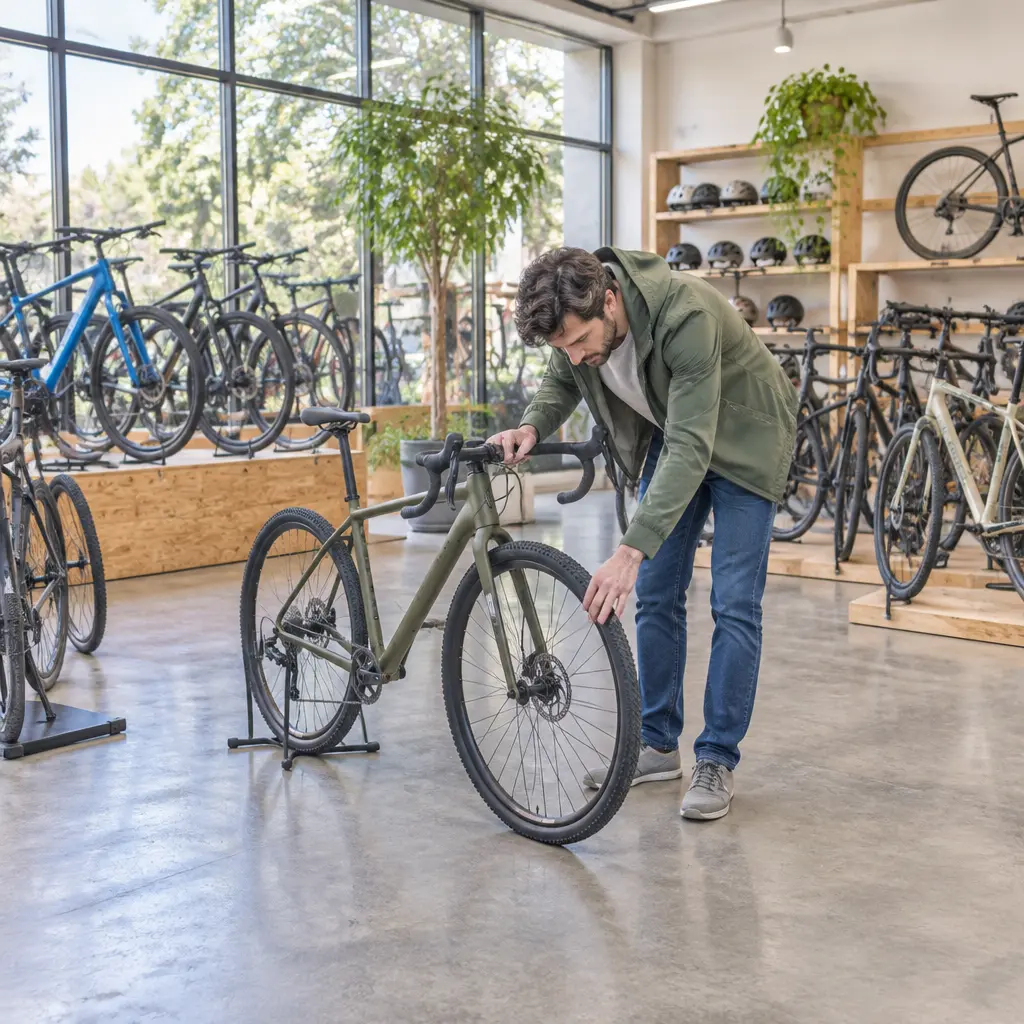
Inspect the frame, fork, and steering
The frame supports the rider and connects the bike’s main components; the fork holds the front wheel and helps guide the bike. Look closely for cracks, dents, deep scratches, corrosion, or signs of a repair, especially around welds, joints, and areas where components clamp to the frame. On a carbon-fiber frame or fork, get expert advice about any impact damage or suspicious marks because appearance alone may not establish whether the structure is sound.
With the front brake applied, gently rock the bike forward and back to check for movement or knocking around the steering assembly. Turn the handlebars from side to side: they should move smoothly, without binding. If the seller will not allow a careful inspection or a shop assessment, treat that as a reason to walk away.
Test the brakes and wheels
Brakes should engage predictably and bring the bike to a controlled stop. Check that each lever feels firm, does not pull all the way to the handlebar, and operates its brake correctly. Inspect brake pads for wear and check that rims or rotors are not visibly damaged. During the test ride, try each brake separately at low speed in a safe, clear area.
Spin each wheel and look for side-to-side wobble, rubbing, loose spokes, or a tire that does not sit evenly on the rim. Lift each wheel and gently try to move it from side to side; noticeable play can indicate a maintenance problem. A wheel that is badly out of true, or a cracked rim, warrants professional attention before riding.
Evaluate tires, gears, and drivetrain wear
Tires are the bike’s contact with the ground, so inspect them for cuts, exposed threads, bulges, and dry cracking. Check that both tires hold air and that their size suits the bike and the surfaces you plan to ride. A worn tire may be replaceable at a predictable cost, but include that cost in your offer or budget.
The drivetrain—the chain, chainrings, cassette, and derailleurs on many bikes—transfers pedaling force to the rear wheel. Shift through the available gears while pedaling gently; changes should be reasonably smooth, without persistent skipping or grinding. Look for a rusty or stiff chain and heavily worn teeth. The Park Tool Company notes that chain wear can be measured with a chain checker; a mechanic can assess whether the chain or other drivetrain parts need replacement.
A good bike’s test ride, history, and total cost
A stationary inspection can reveal obvious damage, but a test ride can expose handling, fit, and shifting problems that are hard to notice at a glance. For a used bike, the purchase decision should also account for ownership history, proof of lawful ownership, and the cost of any immediate repairs. These checks connect the bike’s present condition with the practical question of whether it is a sound buy.
Take a safe, purposeful test ride
Ride in a safe area with the seller’s permission and wear a properly fitted helmet. Start slowly, test both brakes, shift across the gears, ride briefly out of the saddle if appropriate, and make gentle turns. Listen for repeated clicks, creaks, grinding, or clunks, and notice whether the bike tracks straight and feels stable. A short ride cannot guarantee that every component is sound, so it complements rather than replaces an inspection.
If the bike is an e-bike, check the display, assistance levels, controls, charging equipment, and battery condition. Ask about the battery’s age, storage, and replacement availability, and have a qualified technician inspect electrical faults or damage. A battery that powers on is not, by itself, proof of good remaining range or safe condition.
Verify a used bike’s identity and ownership
Ask for the frame serial number, a receipt, and any maintenance records. The serial number is commonly stamped or labeled on the frame, often near the bottom bracket, though locations vary. Search the number using reputable bike-registration or stolen-property resources available in your area, and compare it with any paperwork. A missing receipt does not automatically prove a bike is stolen, but an altered or removed serial number, an implausibly low price, or a seller who cannot explain ownership deserves caution.
For a higher-value used bike, arrange an independent inspection at a reputable bike shop before paying. Agree in advance on the inspection cost and what happens if the mechanic finds a serious fault. Avoid sending a deposit before verifying the seller and bike, and use a payment method and meeting place appropriate to the transaction.
Calculate the real purchase cost
The purchase price is only one part of a bike’s cost. Add likely repairs, a correctly fitted helmet, a lock, lights, and any commuting accessories you need. For a used bike, request a written estimate for necessary work; a bargain can become poor value if it needs a wheel rebuild, drivetrain replacement, or battery service immediately.
Compare bikes of similar type, condition, and equipment rather than judging by brand name alone. Ask about the warranty and return policy for a new bike, and whether the seller includes a first adjustment or service. If you are unsure, a mechanic’s inspection and a clear repair estimate are often more useful than a confident sales pitch.
Conclusion: choose a bike you can ride safely and maintain
A good bike matches its rider and intended use, fits comfortably, and has sound frame, wheels, brakes, tires, and drivetrain. A deliberate test ride helps reveal how it behaves, while a check of records, serial number, and likely repair costs helps make a used-bike purchase more informed. Before buying, compare suitable models, inspect the specific bike, and ask a trusted mechanic to assess anything you cannot verify. Then budget for a helmet, lights, and a lock so the bike is ready for the rides you actually plan to take.
Sources: U.S. Consumer Product Safety Commission, Bicycle Requirements Business Guidance, https://www.cpsc.gov/Business–Manufacturing/Business-Education/Business-Guidance/Bicycles; National Highway Traffic Safety Administration, Traffic Safety Facts: Bicyclists, 2023 Data, https://crashstats.nhtsa.dot.gov/Api/Public/ViewPublication/813740; Park Tool Company, Chain Wear: How to Know When to Replace Your Chain, https://www.parktool.com/en-us/blog/repair-help/chain-wear-how-to-know-when-to-replace-your-chain
Related Post

Carrying a full workday on two wheels without looking ridiculous
A practical two-wheel workday setup is a bicycle or e-bike paired with clothing, bags, and [...]
What mechanics wish cyclists knew before showing up
A bicycle mechanic is a trained technician who inspects, maintains, and repairs bicycles and their [...]